 Sequaris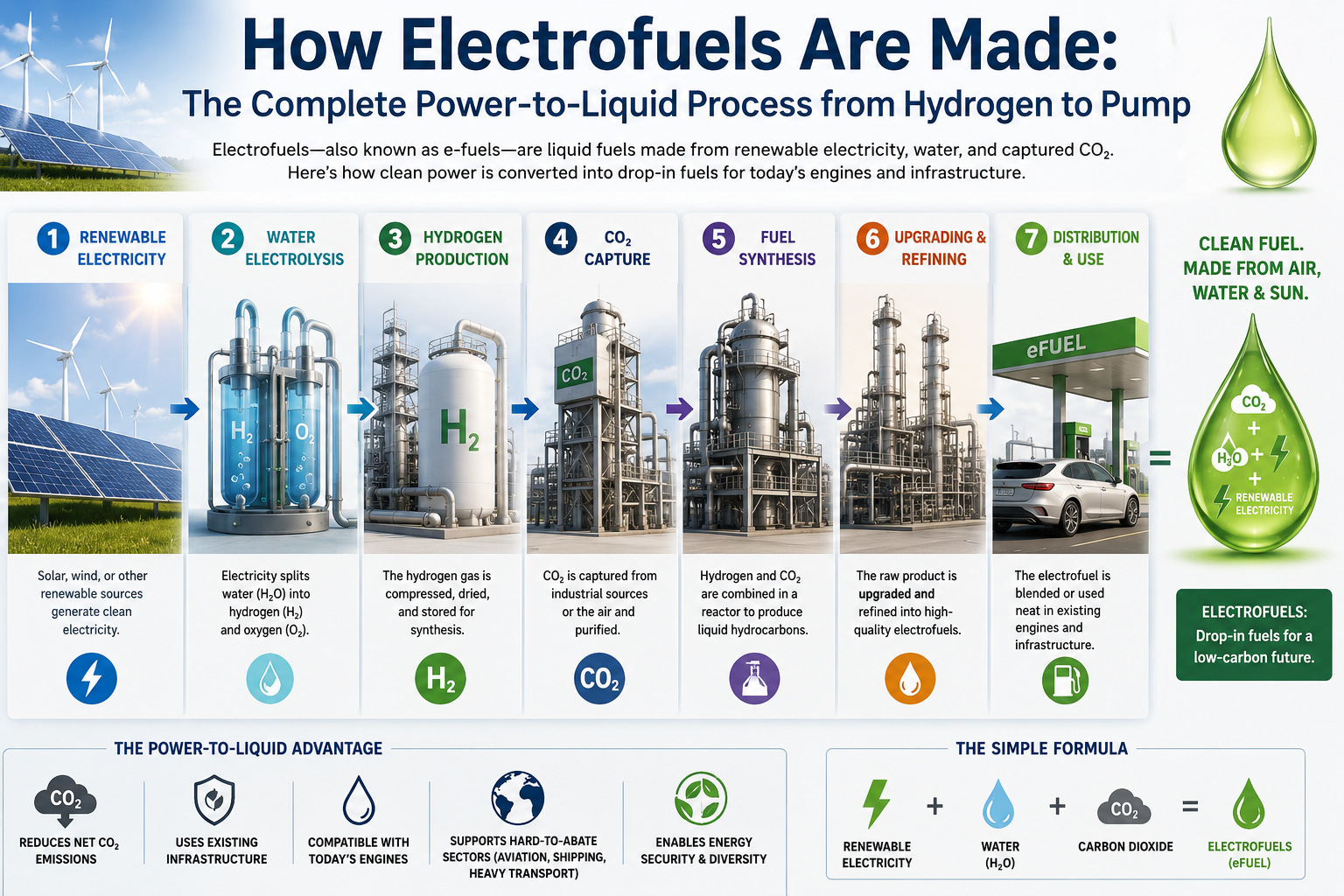

How Electrofuels Are Made:
The Complete Power-to-Liquid Process from Hydrogen to Pump
Electrofuels — also called e-fuels, Power-to-Liquid fuels, or synthetic fuels — are liquid hydrocarbons chemically identical to fossil petrol, diesel or kerosene, produced from green hydrogen and captured CO₂ using electricity from renewable sources. The technology is not new: the underlying Fischer-Tropsch process was invented in Germany in 1925. What is new is the industrial-scale demonstration happening right now, from INERATEC’s ERA ONE plant in Frankfurt to Norsk e-Fuel’s facility in northern Norway. This article explains exactly how the process works — step by step — and why the cost of the hydrogen feedstock is the single most important variable in making electrofuels economically viable.
The Four Steps of Power-to-Liquid — From Electricity to Fuel
Every electrofuel production facility follows the same fundamental sequence, regardless of whether it produces e-kerosene, e-petrol, e-diesel or e-methanol. The four core steps are hydrogen production, CO₂ capture, synthesis gas generation, and Fischer-Tropsch fuel synthesis. Each step has its own efficiency profile, cost drivers and technology options — and each is the subject of active industrial development.

Fischer-Tropsch — The Core Chemistry That Has Not Changed Since 1925
The Fischer-Tropsch process was developed by German chemists Franz Fischer and Hans Tropsch at the Kaiser Wilhelm Institute in 1925. The core reaction is straightforward: carbon monoxide and hydrogen — the synthesis gas — react in the presence of a metal catalyst to produce long-chain hydrocarbon molecules. These molecules are chemically identical to those found in fossil fuels. The same process was used by Nazi Germany to produce synthetic fuels from coal, and by South Africa’s Sasol to produce fuels from coal and natural gas throughout the apartheid era.
What makes the modern Power-to-Liquid application different is not the chemistry — it is the feedstock. Instead of fossil carbon from coal or natural gas, the carbon comes from captured CO₂. Instead of fossil-derived hydrogen, the hydrogen comes from water electrolysis powered by renewable electricity. The result is a fuel that is chemically identical to fossil petrol or kerosene but produced with near-zero net lifecycle carbon emissions.
Improving yields is currently the most impactful lever for scaling e-SAF production — especially while critical inputs like green hydrogen remain scarce.
Dirk Uys · Vice President Sales · Sasol Chemicals · 2026INERATEC ERA ONE — Europe’s Most Advanced PtL Plant
INERATEC’s ERA ONE facility at Frankfurt Höchst Industrial Park is currently the most advanced Power-to-Liquid plant in Europe. Fully commissioned in June 2025, it uses microstructured Fischer-Tropsch reactors — a KIT innovation — that are highly efficient, modular and container-scalable. The plant produces synthetic fuels including e-kerosene on a ton scale for the first time.
In 2026, INERATEC and Sasol Chemicals deepened their partnership with a signed Letter of Intent targeting a 15% boost in e-SAF yield through next-generation cobalt-based Fischer-Tropsch catalysts. The advanced catalyst, expected to be commercially available by 2026, will be deployed across INERATEC’s PtL plants. Sasol’s cobalt catalysts are the result of nearly a century of innovation, originating from the pioneering work of Fischer and Tropsch and brought to industrial scale by Sasol since the 1950s.

The Heat Recovery Advantage — Why Exothermic Reaction Matters
One of the most economically important features of the Fischer-Tropsch process is that it is exothermic — it releases heat. In a well-designed Power-to-Liquid plant, this heat is continuously recovered and used in other process steps — particularly in the reverse water-gas shift reaction and in the electrolysis preheating. Norsk e-Fuel’s process design explicitly recovers the significant heat produced in the FT reactor, using it in upstream process steps to increase overall efficiency.
This heat recovery is not a minor optimization — it is central to the economic case for electrofuels. Research from Karlsruhe Institute of Technology shows that carbon-to-fuel conversion can reach 91% in fully electrified PtL configurations with proper heat integration, compared to 37% in biomass-only configurations. The difference represents the gap between an economically marginal process and a commercially viable one.
- No heat recovery — carbon-to-fuel efficiency ~37% · significant energy waste · uncompetitive economics
- Partial heat recovery — efficiency ~60% · production costs reduced up to 40% vs fully electrified no-recovery
- Full electrification + heat recovery — efficiency up to 91% · highest carbon efficiency achievable · requires low-carbon grid
- Co-electrolysis advantage — Sunfire 220kW system converts H₂O + CO₂ → syngas in single step · eliminates RWGS reactor · increases system efficiency
The Natural Hydrogen Game-Changer — Why Lorraine Changes All the Maths
Every economic analysis of electrofuels arrives at the same bottleneck: the cost of green hydrogen. At current electrolytic green hydrogen prices of €6.20 per kilogram in Europe, e-petrol costs approximately €3.40 per litre to produce and e-kerosene approximately €7.70 per litre — multiples of their fossil equivalents. The electrolyser electricity cost alone accounts for 60 to 70% of total production cost.
Natural geological hydrogen — if confirmed commercially viable at the REGALOR II borehole in Lorraine and potentially in the Belgian subsoil under the BE.Hydrogen programme — targets a production cost of €0.50 per kilogram. At that price, extracted from the ground without electrolysis and without electricity input, the entire economics of Power-to-Liquid fuels changes:
- E-kerosene today (green H₂ €6.20/kg) → production cost ~€7.70/L → 12× fossil jet A-1 · mandates required for viability
- E-kerosene with natural H₂ (€0.50/kg) → production cost ~€3.00/L → 4× fossil · ReFuelEU 6% mandate economically manageable
- E-petrol today (green H₂ €6.20/kg) → production cost ~€3.40/L → 2× fossil pump price · EU exemption required
- E-petrol with natural H₂ (€0.50/kg) → production cost ~€1.80/L → approaching pump parity · market-competitive with carbon pricing
- Key date — REGALOR II commercial results 2027 → investment decision for Greater Region PtL plant → first production 2031–2032
The Greater Region — Belgium, Luxembourg, Lorraine and Saarland — already has the industrial CO₂ sources (ArcelorMittal, TotalEnergies Feluy), the planned hydrogen transport infrastructure (HY4Link pipeline, EU PCI status), and the proximity to Europe’s largest automotive and aviation clusters. If Lorraine natural hydrogen is confirmed at scale in 2027, the Greater Region has every element needed for Europe’s first cost-competitive electrofuel production hub.
The Fischer-Tropsch process has been waiting a century for the right hydrogen feedstock. Natural hydrogen may be the answer that makes it commercially inevitable.
- → INERATEC — “Increasing efficiency in the production of sustainable aviation fuels” — 2026
- → INERATEC — “First industrial scale pilot plant for Power-to-Liquid” — ERA ONE Frankfurt Höchst
- → INERATEC + Sasol — “Catalyst for Impact: deepened partnership to maximize e-SAF yields” — 2026
- → Norsk e-Fuel — “Our Technology” — Fischer-Tropsch pathway — Mosjøen Norway
- → Science|Business — “Europe’s electrofuel companies prepare for life on the road” — 2025
- → KIT / P2X Kopernikus — Climeworks · INERATEC · Sunfire — integrated PtL pilot
- → ScienceDirect — “Electrification-enabled production of Fischer-Tropsch liquids” — May 2025
- → ScienceDirect — “Liquid e-fuels: comprehensive review” — September 2025
- → FDE / REGALOR II — Lorraine natural hydrogen · Pontpierre 3,655m
